
Generative AI arrived not so long ago, and we can all feel a growing shift in paradigm. Let’s admit it: we all have mixed emotions about it, somewhere between FOMO (fear of missing out), enthusiasm, fear, a sense of losing our bearings, and opportunism. But I think one question is on all our minds, whether we are parents, students about to enter the job market, managers or business leaders: if AI does the junior work, where will tomorrow’s seniors come from?
Where are the juniors?
We already have some early answers. In the United States, according to a Stanford study1, employment of 22 to 25 year olds in the jobs most exposed to AI is now 19% below its trend, while their more experienced colleagues are unaffected. A Harvard study2 points the same way: in firms that adopt generative AI, junior employment fell by about 9% within eighteen months. That is too fast to be explained by tasks actually being automated; the authors see it as anticipation: firms stop hiring for roles they expect to hand over to AI soon. In other words, we are cutting the talent pipeline on a promise, not on a result.
And Europe is doing no better, quite the opposite: according to the Linux Foundation3, entry-level technical roles fell by 3% there in 2025, while they grew by 14% in the rest of the world.
A brilliant junior, but a plausible one
Not long ago, a business plan came my way. Someone close to me, with whom I was discussing the opportunity, had the idea, as we all do now, of running the due diligence through Perplexity. Within minutes, the analysis was there: complete, well structured, very positive about the opportunity, with a few minor points of attention.
But something bothered me: the famous gut feeling. It was too good, too positive. Besides, having already read the documents, I found the case a little thin. So we redid the exercise. It took us a good half-day, but we found that the forecasts were too ambitious, that the underlying conditions were mentioned but not detailed, that the various valuation calculations did not add up, and so on… We then had the good idea of feeding all this back into the original Perplexity conversation, which had no other answer than: “You’re right…”. This is, incidentally, a well-documented behaviour of these models, which tend to side with their user4.
What is interesting about this story is that this person was far from a junior: he does this kind of analysis regularly. It shows that judgement and critical thinking are kept alive through experience and continuous learning; they are not acquired once and for all.
But what would have happened if a junior had had to do this analysis, or to shortlist the viable business cases before passing them up to their manager? They would probably have used AI; they would even have been encouraged to. Or, more likely still, there would have been no junior at all: a senior would have been asked to handle more of them, for productivity’s sake, with the help of an AI assistant.
Because today’s AI assistants are juniors of a very high calibre: fast, tireless, articulate. But what they produce is plausible, not reliable. They need someone to frame the request, refine it and read the result with a critical eye. An experiment run by Harvard researchers with Boston Consulting Group (BCG)5 actually measured this. On a case designed so that the AI would get it wrong, consultants using it found the right answer less often than those working without it (60 to 70% against 84.5%). More troubling still, their recommendations were rated as higher quality, even when they were wrong.
The irony of automation
In 1983, long before generative AI, an engineering psychologist, Lisanne Bainbridge6, described what she called the ironies of automation. We automate because we consider the human unreliable, and then we leave the human what the machine cannot do: the difficult cases. An operator who only watches loses the skill, and watches poorly a system that works almost all the time.
“Perhaps the final irony is that it is the most successful automated systems, with rare need for manual intervention, which may need the greatest investment in human operator training.”
Lisanne Bainbridge, Ironies of Automation, 1983
These are exactly the arguments used today to sell automation business cases (with AI or without): the human is “imperfect”, and their mind should be kept for the specific cases, not the standard ones. A further irony: those standard cases are precisely the ones juniors learn on. So we can see something visionary in Bainbridge. And it will only grow: the “better” the AI, the more we need people who can see when it is wrong. And that ability is built by doing.
Looking back, if I am where I am today, it is because I was lucky enough to touch a bit of everything in data and AI. I trained as a data scientist, but I quickly understood all the underlying factors that shaped how my models behaved once in production. I came to data pipelines, governance and data platforms because my models carried biases that came from upstream. I learnt the dependencies by tripping over them.
And that, I believe, is the definition of a senior: someone who can understand and anticipate. It is the difference between watching a tutorial on how to build a piece of furniture and building it yourself. The ready-made one looks fine, until you move house and have to take it apart.
What changes the game, unlike the calculator that replaced the abacus without risk, is that AI is plausible: we cannot stop knowing what to check. Which brings us back to our famous productivity gains, measured only in time saved, when the danger is not work done badly; it is wrong work that looks well done.
Good form. But what about substance?
The honest objection is that AI helps beginners most. The BCG experiment shows it clearly: on tasks where AI is comfortable (coming up with a product, writing, persuading), below-average consultants improved by 43%7. Likewise, the least experienced agents in a customer support team resolve 34% more requests per hour with an AI assistant, according to a study by Stanford and MIT researchers published by the National Bureau of Economic Research8.
But on closer inspection, the Harvard employment study mentioned above shows that, even though juniors are more productive, fewer of them are hired: the tasks they used to do “disappear”, and the more senior tasks do not come down to them. And the customer support study reveals that the AI had been trained on the conversations of the best agents: indirectly, it was spreading the seniors’ know-how. So, without seniors, who will the AI keep learning from?
In the end, feeling productive is not the same as being productive.
Did you know? In a 2025 study, experienced developers believed AI had made them 20% faster. When measured, they had been 19% slower9.
From Ford to Toyota
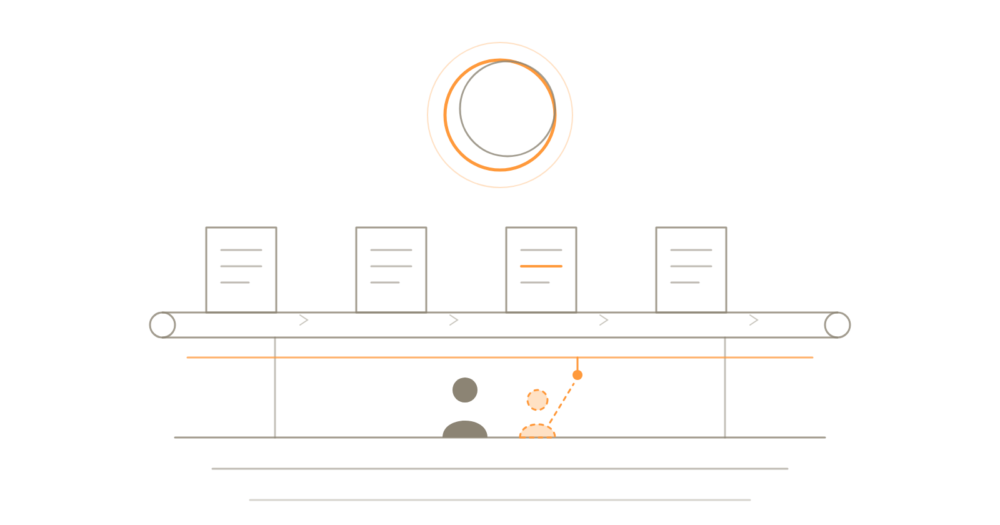
I have long been convinced that service work increasingly resembles a production line. And on that ground, industry has already tried two ways of running one: Fordism and jidoka.
Fordism deskilled the worker: one gesture, repeated, with no need to understand the whole, and we know the damage that followed. Perhaps you have already come across it in a department (or several).
Toyota answered with jidoka, “automation with a human touch”: any operator can stop the line as soon as a defect appears, so that it never reaches the next station10. But of course that only works with operators who understand the whole production line.
In my view, this is the model service companies should follow with AI. It will also be, I think, the best way to demonstrate the real viability of an AI automation project. But it calls for qualified line “operators”, with a full understanding of the processes, of what lies beneath them and of how they work.
Regulation already says as much. The AI Act asks organisations to take measures to develop the “AI literacy” of their staff, and to assign human oversight to people with “the necessary competence, training and authority”11. The paradox is that too many organisations treat this as a constraint and respond with an awareness session that will serve as evidence in an audit. The Digital Omnibus of July 2026 has even softened it: it is no longer about ensuring a sufficient level, only about taking measures. Settling for a session, though, misses the European Union’s deeper intention, all the more so as these principles already appeared in 2019 in the Ethics Guidelines for Trustworthy AI12, whose first requirement was human agency and oversight. Not on the scale I described above, admittedly, but the principle was there.
What managers can do
After all these observations, what can be done? I will leave aside education and apprenticeship, which in my view are national and European issues: they are the foundations of the society we want in twenty or forty years, and they should be laid now, because education changes slowly.
Every company and every manager has an important role to play in keeping knowledge of high quality over time. Here are three practices I have applied and would not hesitate to apply again.
Sketch first, then compare, and play the challenger. Make your juniors face the blank page before the AI, then challenge them. With mine, I would start by giving them frameworks. I took the time to explain them, then let them use them and come back to me with their point of view. Once they were comfortable enough, I let them build their own structure. But they had to come with their own draft. The key is being able to get past the blank page yourself, ideally with a paper draft. Only then compare with what the AI produces. The idea is that the junior should be able to answer the famous “five whys”. The senior does not correct; the senior asks.
Did you know? The “five whys” method also comes from Toyota: faced with a problem, ask “why?” five times in a row to get to its root cause13.
Reinvest part of the gain. Explicitly channel part of the time saved by AI into training: pairing, reviews with comments. Even if it is hard to account for, this is how productivity should pay for competence. Bainbridge said it forty years ago: the more successful the automation, the more you need to invest in training people.
Grant the right to make mistakes, and cover them. Let your juniors make mistakes, in front of real counterparts, and be there to catch them. It is the most important point, but also the hardest, because it takes a lot of stakeholder management and, above all, support from top management. Let’s be clear, this is not a free-for-all, but you learn to walk by falling. I always looked for counterparts who would accept a mistake as long as I covered it, so that juniors could step up quickly.
A simple but telling example. In consulting, developing your juniors is one of the foundations of the job, because value is measured by the level of seniority the client perceives. In my previous roles, I made sure, quite early on, that juniors presented to clients themselves the analyses they had carried out or the solution they had built, and tried to answer their questions, depending on the client and the type of meeting, of course. Always with me in the room: if I sensed the junior would not manage to answer, or that the client did not understand the answer, I stepped in. Like any first time, it is never perfect, but the juniors quickly felt what was not working and could critique themselves, and then we talked it through together. It helped them progress faster and understand what the last link of their work really is: a deliverable that works for the client, that the client understands and can make their own, and satisfied sponsors.
In my experience, productivity goes up, but so do the junior’s confidence and their understanding of the real limits of their skills; they learn faster and become independent all the sooner. My own output was lower, admittedly (or done outside office hours), but the team’s was far higher.
And for juniors
I have always thought there were two paths, as in medicine: the specialist and the generalist.
For the specialist: someone will always be needed to challenge, clean up, optimise and adapt what AI produces. Because at a certain level, the smallest optimisation saves significant costs. In software development, for example, mediocre code is very expensive to maintain and run, and oversizing the hardware does not solve the underlying problem. On the other hand, it will become a true expert’s job, one that grasps all the subtleties.
For the generalist, as I explained earlier, we will need people who understand the whole chain well enough to see and anticipate the impacts, challenge, and keep the whole thing running. People who are able, beyond operating these processes, to design and run them, with or without juniors in the loop in the long run. That is the path I chose: I have always been interested in understanding my field as a whole and in mastering what is at play beneath the surface. To do so, I practised every link in the chain: that is what lets you estimate what a choice made in one place changes elsewhere.
Whichever path you take, use AI after the effort, not instead of it. And if that helps convince you: an MIT study14 showed that 83% of students who had written an essay with AI could not quote a single sentence of it a few minutes later. By contrast, those who had first written on their own, then used AI, were the most engaged of all.
Conclusion
Now let’s look fifteen or twenty years ahead: who will be able to see that the business plan I mentioned earlier was too good to be true?
Tomorrow’s seniors will not appear on their own. We need to train them differently, but not less, and with seniors’ time genuinely set aside for it: reinvesting today’s productivity gains so that they last.
I will end with this question, for every leadership team: in your organisation, who will be able to say that the result is wrong?
- Erik Brynjolfsson, Bharat Chandar, Ruyu Chen, Canaries in the Coal Mine? Six Facts about the Recent Employment Effects of Artificial Intelligence, Stanford Digital Economy Lab, revised August 2026. https://digitaleconomy.stanford.edu/publications/canaries-in-the-coal-mine ↩︎
- Seyed M. Hosseini, Guy Lichtinger, Generative AI as Seniority-Biased Technological Change, Harvard, May 2026. https://papers.ssrn.com/sol3/papers.cfm?abstract_id=5425555 ↩︎
- Mirko Boehm, Who will be the senior engineers of 2036?, Linux Foundation Europe, June 2026. https://linuxfoundation.org/blog/who-will-be-the-senior-engineers-of-2036 ↩︎
- Mrinank Sharma et al., Towards Understanding Sycophancy in Language Models, Anthropic, ICLR 2024. https://www.anthropic.com/news/towards-understanding-sycophancy-in-language-models ↩︎
- Fabrizio Dell’Acqua et al., Navigating the Jagged Technological Frontier, Harvard Business School and BCG, 2023. https://papers.ssrn.com/abstract=4573321 ↩︎
- Lisanne Bainbridge, Ironies of Automation, Automatica, 1983. An overview: https://blog.acolyer.org/2020/01/08/ironies-of-automation/ ↩︎
- Fabrizio Dell’Acqua et al., Navigating the Jagged Technological Frontier, Harvard Business School and BCG, 2023. https://papers.ssrn.com/abstract=4573321 ↩︎
- Erik Brynjolfsson, Danielle Li, Lindsey R. Raymond, Generative AI at Work, NBER, 2023. https://www.nber.org/papers/w31161 ↩︎
- Joel Becker et al., Measuring the Impact of Early-2025 AI on Experienced Open-Source Developer Productivity, METR, 2025. https://arxiv.org/abs/2507.09089 ↩︎
- Lean Enterprise Institute, Jidoka. https://www.lean.org/?p=3876 ↩︎
- Regulation (EU) 2024/1689 on artificial intelligence (AI Act), Article 4 (AI literacy, as amended by the Digital Omnibus on AI, in force since 27 July 2026) and Article 26(2) (human oversight assigned by deployers). https://eur-lex.europa.eu/eli/reg/2024/1689/oj; unofficial explorer: https://artificialintelligenceact.eu/ai-act-explorer/ ↩︎
- High-Level Expert Group on AI, Ethics Guidelines for Trustworthy AI, European Commission, 2019. https://digital-strategy.ec.europa.eu/en/library/ethics-guidelines-trustworthy-ai ↩︎
- Lean Enterprise Institute, 5 Whys. https://www.lean.org/lexicon-terms/5-whys/ ↩︎
- Nataliya Kosmyna et al., Your Brain on ChatGPT, MIT Media Lab, 2025. https://arxiv.org/abs/2506.08872 ↩︎
Discuss this article
Share your thoughts here
Your message goes to the author by email; it is not published on the site.

